I specialize in helping professional stage performers (musicians, actors, singers, visual artists, writers, dancers and athletes) overcome focal dystonia, yips, and other performance blocks—both on stage and on the sports field.
If you struggle with performance anxiety, involuntary tension, motor disruptions, or find yourself stuck and lacking motivation in your stage or athletic practice I can help you.
My work with clients is supported by the FREE TO PERFORM MODEL, a gently structured, body-mind approach designed to restore natural flow, enhance resilience, and unlock peak performance.
When performing, FLOW is that state of full presence and focus where you are one with the task at hand. Time seems to disappear, and everything feels free, integrated, and effortless.
Accessing flow states allows performers to engage fully in their art or sport without inner interference.
I can help you address the obstacles that interfere with your optimal performance—especially those involved in initiating and sustaining performance ACTION in a state of FLOW—so you can reach authentic presence and expressive power.
We understand that these internal obstacles correlate to survival adaptative holding patterns, and we acknowledge them as:
-
Intrinsically good and intelligent, as these responses reflect how your brain is trying to do something positive for you.
-
That these adaptative responses have developed throughout your life experiences in different levels of the experience to cope with uncertainties in the external and internal environment.
-
Except now these internal holding patterns are inhibiting the mind and body from functioning according to their full potential.
Signs of performance interference
Performance blocks in artists often appear across multiple dimensions:
Cognitive
Cognitive distortions are thoughts based on core beliefs about ourselves, others, and life, experienced as absolute truths. They act as filters through which we perceive the world, intensifying under stress or vulnerability. Common forms include overgeneralizations, rigid “I must…” or “I should…” thoughts, polarized “either-or” thinking, selective perception, unequal comparisons, and exaggerated or minimized interpretations.
Physiological Reactions
These are automatic, unconscious responses from the autonomic nervous system. Your nervous system continuously scans your environment, assessing safety and danger. Some reactions include trembling, hyperventilation, shallow breathing, sweating, gastrointestinal issues, dizziness, numbness, muscle tension or immobilization, increased heart rate, palpitations, and difficulty connecting with or expressing emotions such as anger, sadness, or joy while performing.
Behavioral Responses
These emerge from cognitive and physiological responses. Common behaviors include avoidance (postponing projects, skipping rehearsals, turning down opportunities), blaming others, over-preparing, over-analyzing, struggling to take direction, sabotaging relationships, forgetting lines or movements, and overacting or underacting in performance.
Affective
These involve attachment-related emotions and fears rooted in early experiences. They include fears of criticism, failure, humiliation, disappointing others, looking foolish, or losing approval. Past relational experiences may influence present professional interactions, creating recurring patterns with authority figures or colleagues.
Performance History
Professional setbacks—forgotten lines, failed auditions, missed shots—can leave lasting impressions that reinforce fear and self-doubt.
Feeling some anxiety before a performance is normal and can even enhance engagement. Complete absence of anxiety, however, is not typical when stepping into the unknown of live performance.
What is the Free To Perform Model, and who is it helpful for?
The F2P Model has already supported Grammy Award–winning musicians, best-selling authors, and Olympic athletes worldwide. Our clients include classical musicians, film actors, ballet dancers, runners, and professional football players across Europe’s top leagues, among many other performers from stage and field disciplines.
Developed by performance expert Ruth S.L. Chiles, and described in her books Free to Perform and The Focal Dystonia Cure, this integrative and inner driven approach helps release performance blocks and restore access to your natural state of flow.
To achieve this, the F2P Model integrates body–mind neuroprocessing techniques, relational and emotional attunement, and cognitive psychology. This approach teaches you how to master your knowledge and engagement with your autonomic nervous system’s involuntary mechanisms and patterns that often underlie focal dystonia, yips, stage anxiety, and other performance challenges, such as:
- Performance anxiety
- Focal dystonia / Yips
- Stage fright
- Mental blocks
- Mind blanking
- Loss of motor control
- Lack of motivation
- Self-doubt
- Impostor syndrome
- Any person who wants to expand his/her performance in life!
The methodologies applied
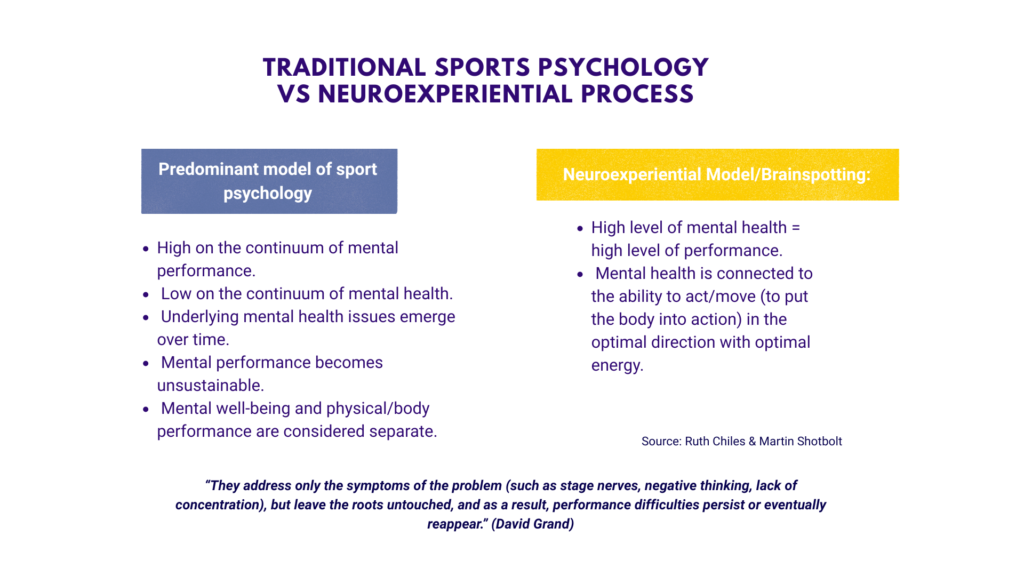
In the Free To Perform Model, we combine two cutting-edge methodologies that have been proven highly effective for performance expansion through numerous cases:
- The Free To Perform Model – which guides you through an arch journey of self attunement, external attunement that leads to deep embodiment and transformation of your relationship to yourself and life. It incorporates Brainspotting as a neuroprocessing tool to highly focus on the mental, emotional, somatic and spiritual experience, through enhanced mindfulness. For a better understanding I highly recommend reading Ruth Chiles’ books!
- The Brainspotting Neuroexperiential Model – a brain-body therapeutic and coaching internationally applied approach developed by David Grand, PhD.
Together, these two approaches allow us to gently rewire your brain, release blocks, and expand your performance at its neurophysiological roots.
Brainspotting
Brainspotting is a dynamic cutting edge therapeutical and coaching technique for the release of emotional cores and the development of expansive performing states.
It is one of the most innovative, organic, powerful and widely investigated methodologies in neuroscience today.
It is an open neuro-experiential model of processing the experience, which offers a different perspective from other therapies by tapping into the brain-body neurophysiology and attuning to the rising inner experience.
There’s a studied correlation between the eye position and the access we have to subcortical memories (emotional cores).
Brainspotting is based on the scanning of the visual field, the angle of the eye position (brainspot), and it’s connection to the neural networks related to a stored experience in the brain-body systems.
As your eyes remain focused in a certain angle (a brainspot!), the optic nerve stimulates in your brain the neural network that activates a particular physiological state connected to memories stored in that specific network.

By letting go of the need to “do it right,” we mindfully observe the brain’s own process of self-regulation—what we call neuro-experiential processing.
Brainspotting addresses the neurophysiological roots of performance blocks and stage fright, helping release them while opening space for the brain to discover new possibilities on its own.
What is the Free To Perform process like?
It is an ONLINE process where we meet weekly via Zoom or other safe platforms. So we can meet from anywhere in the planet!
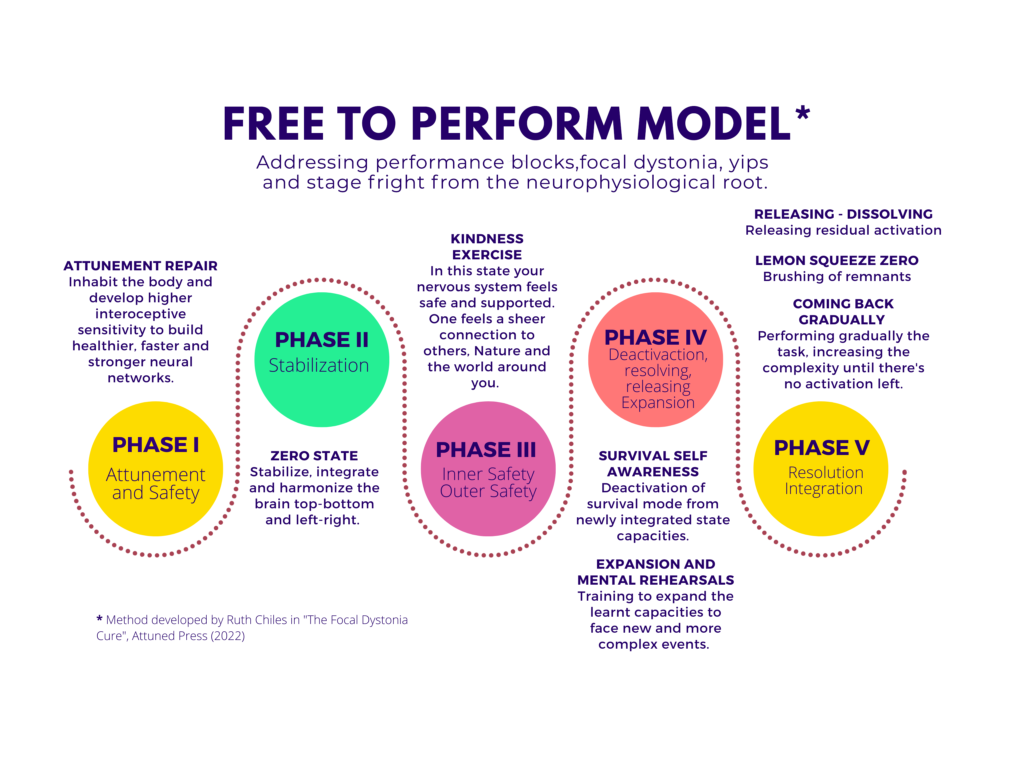
The Free To Perform process invites you to journey through STAGES that include:
1. Identifying disruptive responses and patterns in the cognitive, emotional, and somatic dimensions. The most noticeable of these responses are often the main reasons why clients seek help. Deeper layers of these adaptive patterns, however, tend to be activated outside of conscious awareness.
2. Building inner stability and deep embodiment by learning and mastering Interoceptive, Proprioceptive, Exteroceptive, and Neuroceptive skills—acquiring a profound sense of inhabiting the body from the inside out. This stage supports greater balance, emotional regulation, and mental clarity.
3. Reprocessing old survival-driven disruptive patterns using Brainspotting. [Learn more about the Brainspotting technique HERE.]
4. Expansion Stage: exploring and deeply wiring desired and optimal states for peak performance, both professionally and personally. [Read more about Expansion sessions HERE.]
As a result, artists and athletes can move beyond self-limiting patterns, develop confidence rooted in their own physiology, and sustain authentic, creative, and powerful performances—even in the most demanding environments.
A supervised process.
Since 2020, I have been a member of Ruth’s international team of psychologists, working extensively with this approach and witnessing it’s results. Being still part of the team, the journey we do together will benefit from a “third eye,” as I meet with Ruth regularly for supervision and updating, to ensure my clients receive the fullest potential of this method.
The ultimate step of the Free To Perform process: Expansion
Expansion means opening up to the creating of new states of possibility.
The expansion process comes at the end, once we have ensured you own strong inner resources, inner stability and have established a new relationship towards your craft.
Then it is the time to open up beyond the known!
The experience of expansion propells you from building and integrating new resourceful inner states of self-esteem, empowerment, connection to the definition of a vision, a project or a role, or even states of inner peace and capacity.
It is like imagining a desired self, a possibility of YOU, a quality, a state you want to have access to… and then go and tap on to it, and expand it, and integrate it as part of who you ARE.
This process takes the performance of any actor to a greater level of truth, grit and expressive quality.
The Free To Perform is both a method and a journey—a process that requires commitment and openness, yet leads to the restoration of your natural flow, strengthens resilience, and unlocks the freedom to perform with confidence, creativity, and authenticity in any arena.
Experience the joy of being free to perform!
For a deeper look at what performance blocks really are you can CLICK HERE.
An ONLINE 1-on-1 process to support you in letting go of blocks and unlocking your natural flow in performance, sport, or any creative endeavor.

Click on the band above, or reach me for a first free meeting at: carles@carlesvila.com
In this program, I can help you restore balance and reconnect internally to release, relax, and dissolve physiological and emotional blocks that interfere with your flow, creative freedom, and emotional expression—deeply impacting your self-confidence.
If you choose to commit to the program, you might experience:
-
New ways of performing, feeling, and perceiving yourself as an artist.
-
Greater embodiment, grounding, and ease in your daily life and on stage.
-
Flowing more freely, with tasks and performances feeling natural and effortless.
-
Joy and curiosity in the process, and deeper connection to your work and collaborators.
-
New ideas and creative impulses emerging with ease.
-
Stronger impact in your performances and authentic self-expression.
-
Freedom from blocks, stage fright, or over-/underacting, allowing your optimal states to shine.
-
Greater visibility, confidence, and attraction in professional opportunities.
I say might because the exact outcomes are unique to you. From my experience, most of these transformations do happen—they simply take their own form for each performer. Discovering that form is part of knowing who you truly are.
How long does the Free To Perform process take?
- The Free To Perform process is a simple yet profound journey focused on resolving performance blocks. It is not a regular Brainspotting session or standard therapy, although those can be complementary. The process is structured around the stages of the Free To Perform Method, and each stage must be traveled with careful attunement and respect for your personal rhythm.
- If you are looking for quick results, this program may not be right for you at this time. The goal is deep, lasting resolution. My primary commitment is to your wellbeing—allowing your inner system the time it needs to restore balance before moving toward expansion.
- If you feel you are not ready yet, that is completely fine. I will be happy to begin the work when you feel prepared. In the meantime, I encourage you to explore the exercises and resources I share on social media, which can introduce you to some of the concepts of the method.
- Each stage of the process includes guided therapeutic release work and trainings that you can practice on your own. These exercises support your integration and help develop self-management skills.
- Before starting the process—which requires full commitment from both sides—we begin with an initial evaluation session. This session is free and non-binding. It allows us to understand your needs, answer your questions, clarify the process, and determine whether we are a good fit.
- The duration of the process depends on the complexity of your situation, your inner rhythm, and how long the block has been active. For long-standing or chronic blocks, we may work in short, medium, and long-term phases. On average, performers require 25–35 sessions, but this is only a general guideline. For some, a “full” process does not mean erasing the block completely, but rather achieving the ability to function fluidly, joyfully, and safely without being paralyzed by it—extraordinary progress for artists accustomed to living with tension or pain.
- For example: if you have a broken leg, you may walk again, even if you cannot run a marathon. Similarly, this work is physiological, not magical, and every person’s process is unique.
- Sessions are 75–80 minutes long and typically occur weekly. As progress is made, session frequency can be adjusted. Some clients continue with monthly “maintenance” sessions once blocks are resolved.
- We generally work in blocks of 10 sessions, after which we evaluate progress. The first 3–5 sessions are particularly important to understand your processing style, identify challenges, and estimate the work ahead.
- There is no exact recipe—every person and every process is profoundly unique.
An ONLINE 1-on-1 process to support you in letting go of blocks and unlocking your natural flow in performance, sport, or any creative endeavor.
Click on the band above, or reach me for a first free meeting at: carles@carlesvila.com
Disclaimer: This is a brain-body based performance coaching work focused on physiological blocks that get in the way of your work, it is not a psychological therapy, neither we work to resolve medically framed pathologies. Clients affected by severe trauma or clinically diagnosed pathologies usually require a special placement of the focus on the self-attunement, and inner system stabilization phases, which might extend the process and even be the only work we do. If this is the case we will discuss this in advance. So if you have been diagnosed with any kind of psychiatric or psychological disorder you should let me know in advance so we can evaluate what might a best approach for you.